Guide
Dented Outside Corners and Corner Bead
Every outside corner in a house, where two walls meet and point into the room, has a strip of corner bead under the finish. It's what keeps the edge straight. It's also what takes every bump from a vacuum, a dolly or a laundry basket. Here's what goes wrong and how it gets fixed.
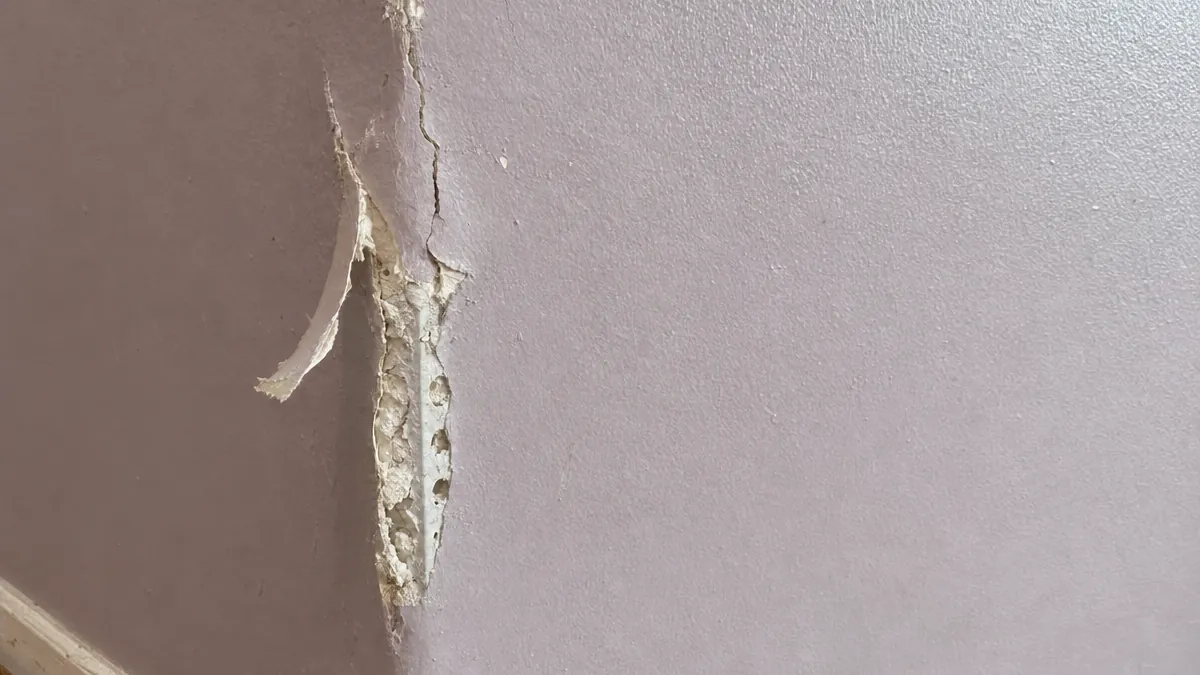
Corner damage: four kinds
Look along the edge with a light. The damage is usually one of these.
Dent
The bead is pushed in but not torn. Small dents are filled and feathered with compound; the bead stays. Run a straightedge along the corner first. If the edge still reads straight above and below the dent, a fill is enough. If the bead itself has bowed out of line, filling only masks it until the next bump.
Crack along the edge
A hairline running up the corner, often where the bead's flange meets the wall. The bead has loosened or the house has moved. Loose bead is re-fastened before the crack is coated.
Crushed or bent bead
A hard hit folds metal bead out of line. The bent length gets removed and a fresh length spliced in, then coated.
Exposed, rusting metal
Paper and compound gone, metal showing, sometimes rust from a damp spot. Rust is treated or that piece is replaced so it doesn't bleed through paint.
Bead types: metal, paper-faced and vinyl
What's under the finish changes the repair. Scrape a little paint off the damaged spot, or look at the torn edge, to see which kind it is.
Bare metal bead
A galvanized steel angle nailed or crimped on, then coated. Strong, but it dents rather than springs back, and loose nails let it crack along the flange.
Paper-faced bead
Metal or plastic with paper laminated over it, bedded in compound like tape. Holds better against edge cracks. The paper can tear or blister if the corner gets wet.
Vinyl bead
Plastic, so it won't rust. It flexes under a hit and sometimes cracks instead of denting. Replaced in sections the same way as metal.
Causes: where corners get hit
Hallway corners, stair edges and the corner by the garage door take the most. Moving weekends batter them, and towns that grow fast see plenty of those: Willow Park's census count rose from 3,982 in 2010 to 4,936 in 2020. Settling plays a part too. When dry-season soil movement shifts the frame, a bead that was only lightly fastened can start to crack along its edge.
Cost drivers: what makes a corner job bigger
No published guide we read prices corner bead repair on its own, so here's what moves the quote. Length of bead to replace. How many corners. Whether rust or water got in behind it. How much texture has to be rebuilt on the two faces. A dent you can fill is a small job; a crushed, floor-to-ceiling stair corner is a bigger one. Grouping several corners into one booking makes the most of the visit.
Prevention: keep the new edge straight
Corners that get hit a lot can take a clear or paintable corner guard after the repair. Some houses switch to a bullnose (rounded) bead on rebuilt corners, which shrugs off bumps better. Bring it up on the pricing call. Inside the garage, a plain metal guard screwed over the corner by the steps is cheap protection against car doors, bins and bikes. Corner repairs pair well with fixing holes in walls and need the same texture blending at the end. To book one, photograph the corner and send it.